Click the left mouse button or tap on the screen to play.
The most important thing to learn is timing.
Your character continues moving automatically, so you need to watch the path ahead and decide when to make each input. A jump that happens too early may cause the character to land in the wrong place, while waiting too long can lead directly into an obstacle.
Rather than clicking continuously, try to make each action purposeful. Watch the spacing between platforms and hazards, then react according to the rhythm of the section.
After several attempts, common patterns become easier to recognize. What initially feels like a reaction test gradually becomes a sequence of movements that you already know.
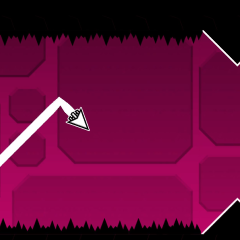
Flying sections require a different approach from ordinary jumping.
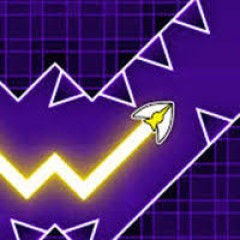
Holding the control raises the character, while releasing it allows the character to move downward. The goal is to keep a stable position while navigating through a limited space.
Large movements are usually harder to control. Smooth adjustments give you more time to correct your position before reaching the next obstacle.
Players who are comfortable with jumping may need a few attempts to adapt to this continuous movement. Once the rhythm becomes familiar, flying sections can become much more manageable.
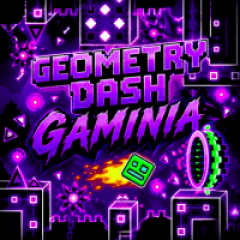
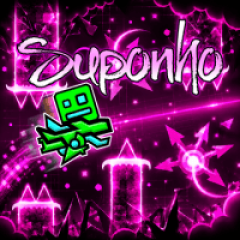
The appeal of Geometry Dash Suponho comes from several elements working together. The gameplay is easy to understand, while the presentation and changing mechanics prevent the experience from becoming monotonous.
The game uses a colorful visual style filled with bright tones and glowing effects. Blues, greens, yellows, and other vibrant colors help create an energetic atmosphere.
The background changes as you progress, giving different parts of the level their own visual identity. Despite the amount of color and movement, the design keeps the main gameplay area readable.
This balance is important in a rhythm platformer. The level needs to look exciting without making upcoming obstacles impossible to recognize.
Visual effects accompany many of the game's movements. Jumps, gravity changes, and portal transitions are supported by animations and particles that make the gameplay feel more dynamic.
These effects add personality to the level without changing the basic objective. You still need to focus on timing, but the presentation makes each successful movement feel more satisfying.
The soundtrack is more than background audio. Its rhythm works together with the level's obstacle placement.
Once you become familiar with the music, certain beats can serve as useful timing signals. A player may start to associate a particular part of the soundtrack with an upcoming jump or transition.
This creates a stronger connection between sound and movement. Instead of watching the screen alone, you can gradually use your ears as an additional guide.
Another attractive feature is the variety of character forms.
Portals can transform your character, introducing different movement behaviors. The cube focuses on timed jumps, while the ship requires continuous control. The ball introduces gravity switching, creating another type of timing challenge.
These changes prevent the level from relying on one mechanic for too long.
Speed portals can make the character move faster or slower. A sudden change in speed forces you to adjust your timing instead of relying on the rhythm you used in the previous section.
Fast sections reduce your reaction window and encourage you to anticipate what comes next. Slower sections may appear more relaxed, but accurate timing remains important.
This variation gives the level a changing pace and prevents the gameplay from feeling completely predictable.
Some obstacles can fade in and out or blend into the colorful surroundings. During an initial attempt, these hazards may be difficult to notice.
After discovering their locations, however, you can remember where they appear and prepare for them during future runs.
This creates an interesting relationship between reflexes and memory. Fast reactions help, but knowing what is coming can be even more valuable.
One enjoyable part of the Geometry Dash experience is the ability to give your character a more personal appearance. Geometry Dash Suponho lets players use skins and colors for their character for free, making it possible to create a look that feels more individual.
Character customization may seem like a small feature, but it can make repeated attempts feel more personal.
Instead of seeing exactly the same appearance every time, you can select a style that matches your preference. Bright colors can create a more energetic look, while other combinations may provide a cleaner or more distinctive appearance.
Because the level itself already uses a colorful presentation, experimenting with character colors can make your icon stand out against the background.
The biggest advantage is accessibility. Players can enjoy different visual combinations without needing to pay for basic personalization.
This is especially useful in a game built around repetition. You may spend many attempts learning the same level, so having a character appearance you enjoy can make the experience feel more personal.
Customization does not change the difficulty or movement of the character. Its main purpose is visual, allowing players to choose how they want their icon to look while they concentrate on the challenge.
The colorful environment creates plenty of room for creative combinations.
You can choose contrasting colors that make your character easier to spot, or select a combination that fits the overall visual style of the level.
For players who enjoy customization, this adds a small creative element to an otherwise skill-focused game.
Although the controls are simple, completing difficult sections consistently takes practice. A few habits can make each attempt more productive.
Looking too far ahead can distract you from the movement that needs to happen immediately.
Keep your attention on the next important hazard while staying aware of upcoming transitions. This helps you react without becoming overwhelmed by everything happening on screen.
Listen carefully to the soundtrack and notice how the obstacle patterns interact with the beat.
Once you begin recognizing the rhythm, certain movements can become easier to predict. The music can act as a subtle guide during sections where visual reaction alone feels difficult.
Do not measure your progress only by how far you get in Normal Mode.
A section that you could not pass yesterday may become comfortable after several focused attempts. Practice Mode is particularly useful for this process because checkpoints let you concentrate on one area rather than repeating the entire level.
Speed changes can make the level feel more difficult than it actually is.
When the character accelerates, avoid panicking or making unnecessary inputs. Anticipate the next obstacle and make your movement earlier.
With enough repetition, faster sections become familiar and require less conscious effort.
Once you discover an obstacle that is difficult to see, memorize its position.
On your next attempt, you will already know that danger is approaching. This turns a surprise obstacle into a predictable part of the route.
Since customization is available, try different combinations until you find a look that feels comfortable.
A character that contrasts clearly with the background can also make visual tracking easier during busy sections.
The appeal of Geometry Dash Suponho does not have to end with a single level. Players who enjoy colorful visuals, precise timing, and fast reactions can continue exploring similar fan-made challenges.
Infrunami is another title that fits naturally into this type of gaming session, offering a different level design while keeping the appeal of rhythm-based obstacle gameplay. Moving from one challenge to another can be a good way to refresh your experience after repeatedly practicing the same section.
This variety is useful for players who enjoy learning new patterns rather than staying with one course indefinitely.