How to Play Geometry Dash Demons
Controls
- Click the mouse (or tap the screen on mobile) to make your character jump, fly upward, or activate gravity changes.
- Release the button to return to normal movement.
- Press Z to place a checkpoint during Practice Mode.
- Press X to remove the most recent checkpoint.
Understand every game mode
Throughout each Demon level, your icon transforms into different forms, each with its own movement style.
Cube
The Cube automatically moves forward. Your only job is to jump at exactly the right moment while avoiding spikes, pits, and moving hazards.
Ship
Hold the mouse button to fly upward and release it to descend. Smooth control is essential because narrow tunnels leave almost no room for mistakes.
Ball
Each click reverses gravity instantly. Timing becomes even more important since gravity portals often appear in rapid succession.
UFO
Instead of continuous flying, every tap makes the UFO bounce upward. Controlled tapping helps you stay on the correct path.
Wave
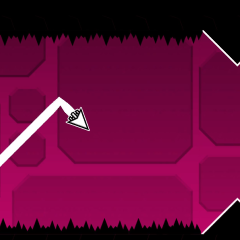
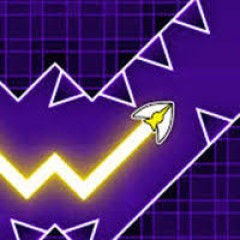
The Wave is widely considered one of the hardest forms. Holding the button sends the wave diagonally upward, while releasing sends it downward. Tiny movements make a huge difference in tight corridors.
Learn the rhythm
Unlike many platform games, Geometry Dash Demons combines music with gameplay. Listening carefully to the soundtrack often helps players anticipate jumps, portals, and transitions before they appear on screen.
What counts as a victory in Geometry Dash Demons?
Victory in Geometry Dash Demons is achieved by completing the entire level from start to finish without crashing before the goal.
Unlike games that reward defeating enemies or collecting items, success here depends entirely on surviving every obstacle.
Reach 100% completion
The progress bar at the top of the screen shows how far you've advanced through the level.
Your objective is simple:
- Reach 100% completion.
- Avoid every obstacle.
- Survive every gameplay transformation.
- Maintain precise timing until the very end.
Many Demon levels include fake endings, sudden speed changes, invisible hazards, and unexpected gravity switches designed to surprise even experienced players.
Accuracy matters more than speed
The game automatically moves your character forward, so there is no need to rush.
Instead, focus on:
- Reading obstacle patterns.
- Timing every jump.
- Learning difficult sections.
- Building muscle memory.
Small improvements quickly add up. Reaching 40%, then 60%, then 80% is often the natural path toward finally completing an entire Demon level.
Every completion feels rewarding
Finishing a Demon level is considered a major achievement within the Geometry Dash community. Because these stages require persistence and concentration, completing one often feels much more satisfying than finishing several easier levels.
Players looking to continue their progression after mastering beginner Demon stages can explore additional Geometry Dash Demons challenges. Different Demon maps introduce fresh obstacle designs and creative mechanics, making every completion an opportunity to sharpen your platforming skills even further.
Is there a Practice Mode, and what is it used for?
Yes. Practice Mode is one of the most valuable features in Geometry Dash Demons.
Instead of forcing players to restart from the beginning after every mistake, Practice Mode allows checkpoints to be placed manually throughout the level.
Place checkpoints
During Practice Mode:
- Press Z to create a checkpoint.
- Press X to remove the most recent checkpoint.
Whenever you crash, you'll restart from your latest checkpoint instead of the beginning.
Learn difficult sections
Many Demon levels contain extremely challenging sequences that require perfect execution.
Practice Mode allows players to repeat these sections until they become comfortable with:
- Wave corridors
- Ship tunnels
- Gravity portals
- Tight jump combinations
- Fast transitions
Repeated practice gradually builds muscle memory, making the same section much easier during a normal attempt.
Improve consistency
Consistency is the biggest difference between experienced players and beginners.
Rather than relying on luck, Practice Mode helps players perform difficult sections correctly over and over again.
Eventually, those practiced movements become automatic during the full level.
Reduce frustration
Without Practice Mode, constantly restarting from 0% after every mistake can become discouraging.
Checkpoints let players focus on learning instead of repeating easy sections unnecessarily.
Most experienced Geometry Dash players spend significant time practicing before attempting a full completion.
Tips for beating Demon levels
Memorize obstacle patterns
Demon levels reward memory just as much as reflexes.
After several attempts, you'll naturally begin recognizing upcoming jumps, portals, and hazards before they appear.
Don't panic near the end
Many players lose concentration after reaching a new personal best.
Treat the final section exactly like the beginning by maintaining steady timing and avoiding unnecessary clicks.
Watch your click rhythm
Random clicking usually leads to failure.
Instead, synchronize your taps with the music whenever possible.
Practice one section at a time
Breaking a difficult level into smaller parts makes learning much easier.
Master each section individually before attempting a complete run.
Take breaks
Long sessions often reduce reaction speed.
Returning with fresh focus can sometimes lead to immediate improvement.